
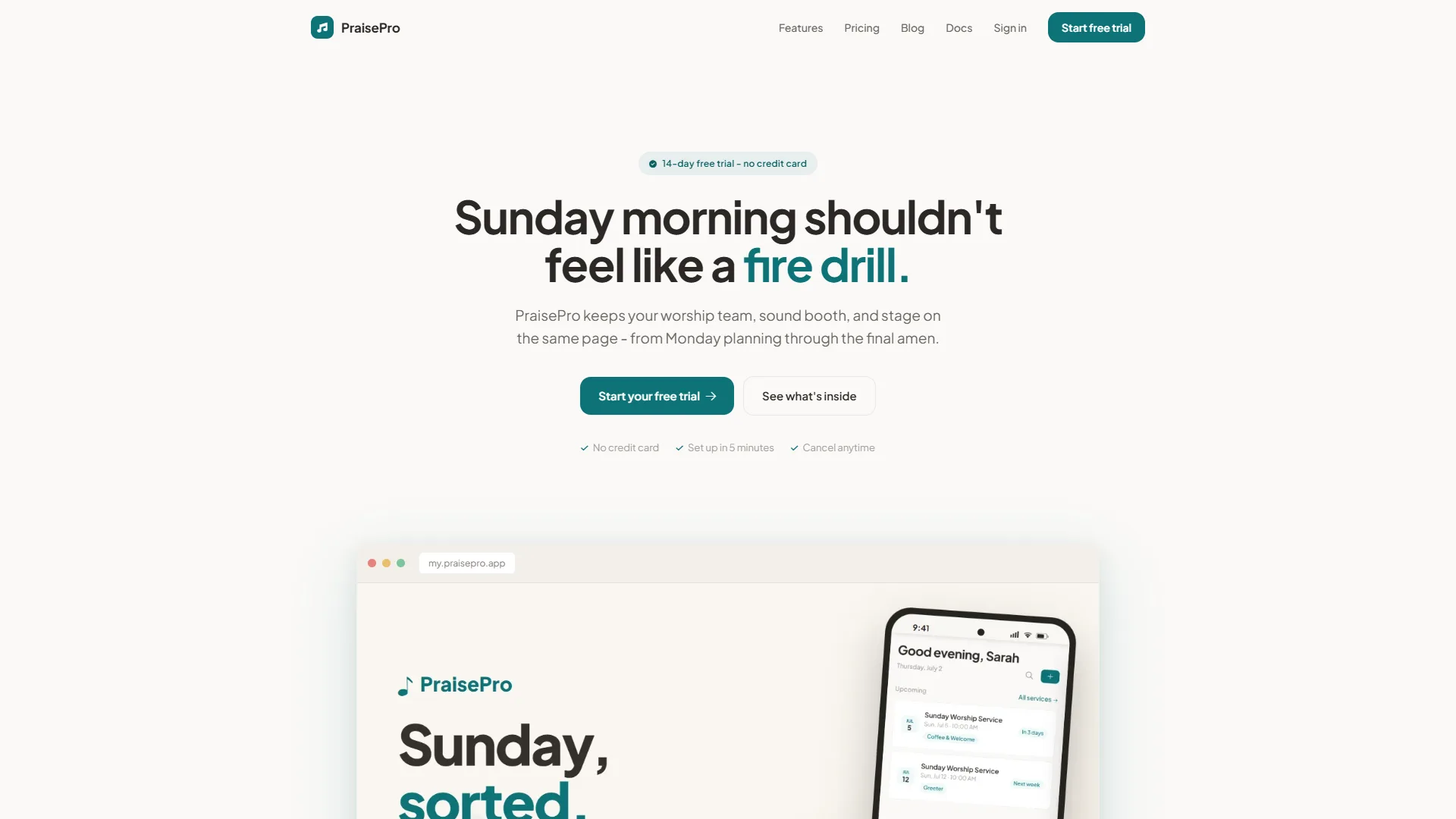
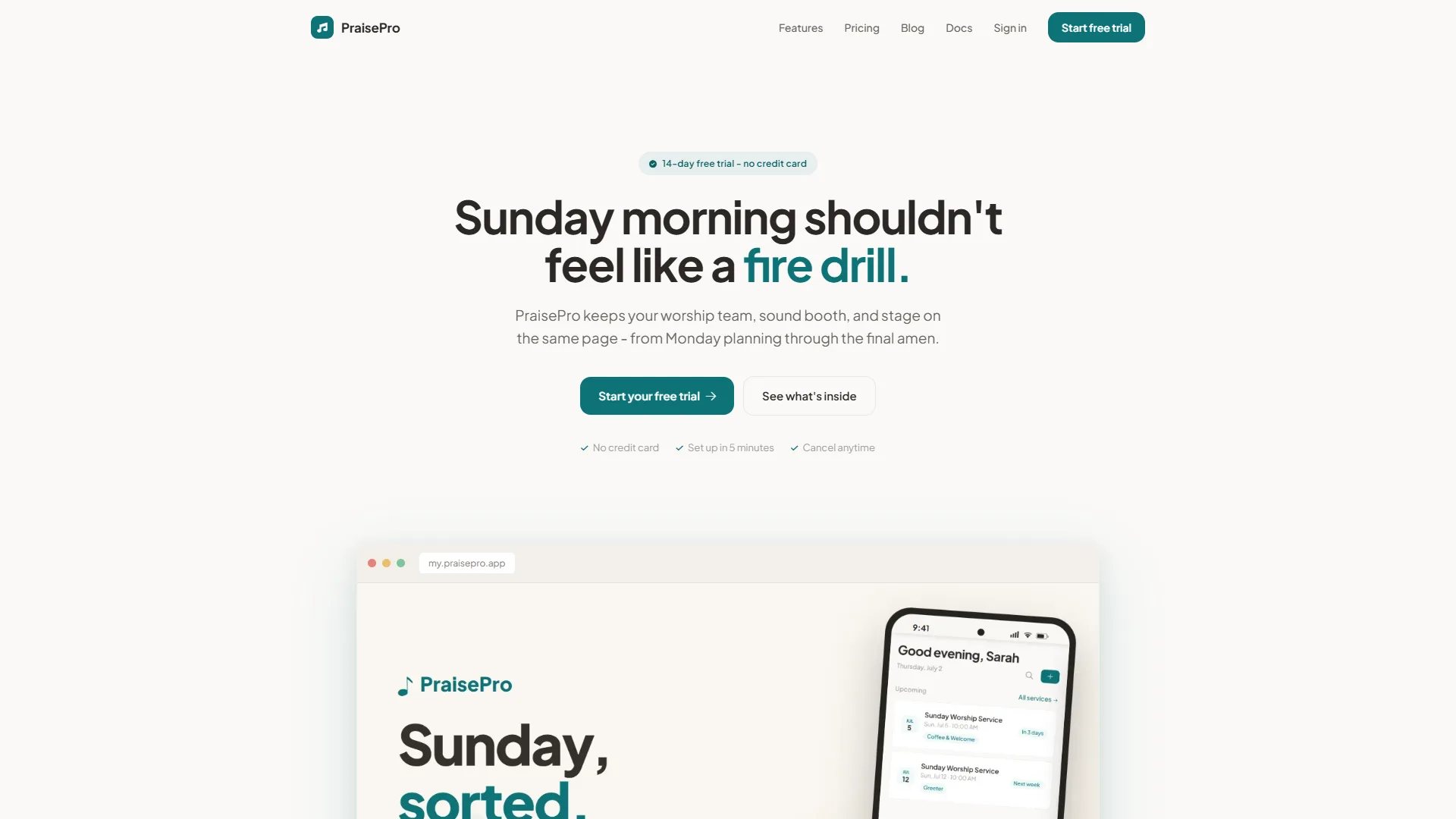
PraisePro is our own product, not client work. It is a scheduling platform for church services, and it exists because I spent years watching the same problem play out every Sunday morning in a room I was standing in.
The Problem
Most churches run their Sunday service on some combination of a group chat, a shared spreadsheet, and one person's memory. It works right up until it does not. Someone does not know they were scheduled. The song list changed on Saturday night and the person running slides never got the update. The service runs eleven minutes long and nobody in the room knows whether that is a problem yet.
None of that is a technology failure. It is a coordination failure, and coordination failures are exactly what software is good at absorbing.
What We Built
The core of PraisePro is the run sheet. You build the order of service by dragging items into place, each with a duration, and the total time updates as you go. If the service is running long, you can see it on Tuesday instead of discovering it on Sunday.
Around that core:
- Team and role scheduling. Assign people to roles, and the system sends the reminders so one volunteer coordinator is not personally texting fourteen people every week.
- Live operator view. A running timer showing where you actually are against the plan, built for the person at the back of the room with a laptop.
- Month calendar with staffing status. At a glance, which upcoming services still have holes in them.
- Music submission portal. PIN protected, so musicians can submit songs without needing an account, because asking volunteers to create accounts is how you get zero submissions.
- ProPresenter and OBS integration through a private RSS feed, so the presentation software pulls the current service instead of somebody retyping it.
Decisions That Mattered
Phone first, not phone compatible. The person checking the schedule is standing in a hallway holding a coffee. They are not at a desk. Every screen got designed for that person first and the desktop layout came second.
No account required to submit music. A PIN and a link. Every extra step between a volunteer and the thing you want them to do costs you a percentage of the volunteers.
Storage tiers instead of user seats. Churches have wildly variable team sizes and charging per person punishes exactly the churches that get the most people involved. The tiers are built around audio storage instead.
What Building a Product Taught Me
Client work has a clear finish line. Somebody signs, you build, you deliver, they pay. A product does not work like that. You can build the entire thing correctly and still be at the beginning, because shipping software and selling software are two different jobs and only one of them is the one I find easy.
That is the honest lesson from PraisePro, and it changed how I think about the client side of this business too. Building was never the hard part.
The Stack
Same approach as everything else we build: no page builder, no bloated framework, no platform we do not control. Custom code, a real database, and hosting we can actually configure. If PraisePro needs a feature next month, it gets built, not requested from a vendor and waited on.
You can see it at praisepro.app, or read more about it on our PraisePro page.